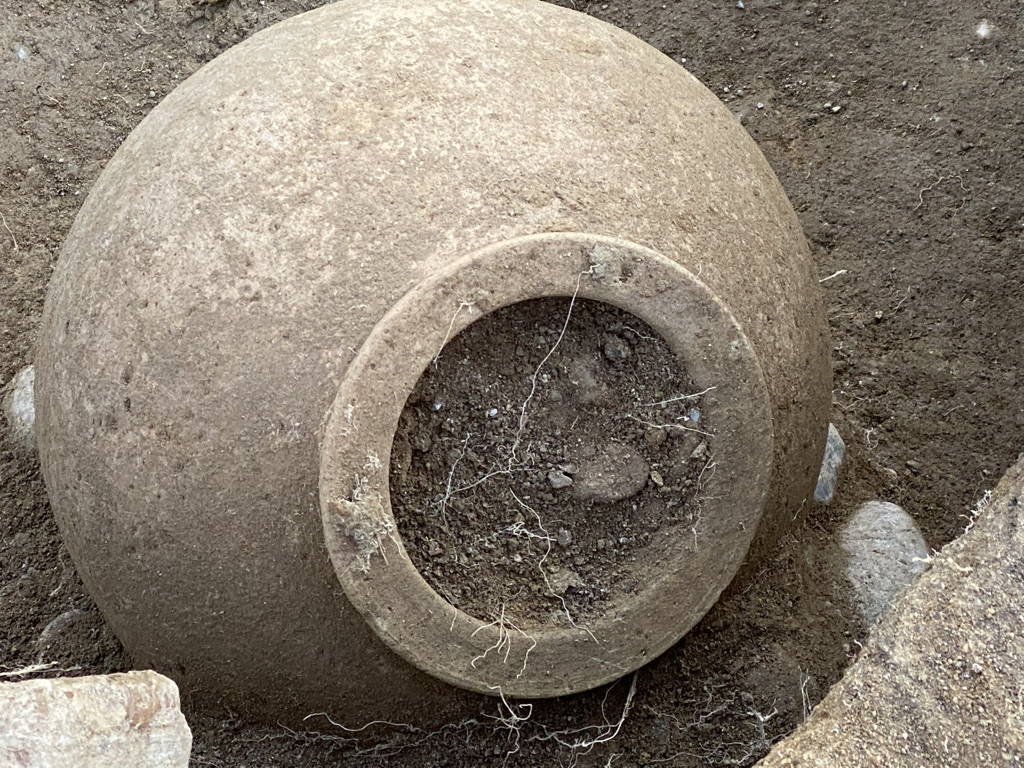
Rusellae, located in the heart of southern Tuscany, is one of the most important archaeological sites for understanding the long-term transformation of urban life in central Italy. Occupied from the Etruscan period through the Middle Ages, the city preserves an extraordinary sequence of monuments, public spaces, and domestic areas that allow us to explore how communities adapted across time.
Etruscan Foundations
The origins of Rusellae date back to the 7th–6th centuries BCE, when it developed as an important Etruscan settlement controlling the fertile plains of the Ombrone River valley and the routes connecting the Tyrrhenian coast to inland Tuscany. The settlement was enclosed by massive polygonal walls, still visible today, which testify to the city’s early role as a regional center of power and trade.
Roman Rusellae
Following the Roman conquest in the 3rd century BCE, Rusellae became a colony and underwent significant urban development. Unlike newly founded colonies such as Cosa, where a strict orthogonal grid was imposed, the Romans at Rusellae chose to respect the earlier Etruscan street network, repaving and monumentalizing existing routes. This produced an urban layout that blended continuity with transformation, resulting in a distinctive city plan that diverged from the canonical colonial model.
Monumental remains from this period are still visible today. These include stretches of the so-called Decumanus, paved with large stone slabs; the forum, constructed over the heart of the earlier Etruscan center; the amphitheater, which hosted public spectacles; and the Domus dei Mosaici, a richly decorated residence that illustrates the wealth of the local elite. Together with the imposing Hadrianic baths of the 2nd century CE, these monuments attest to the prosperity of Roman Rusellae and its role as a hub of agricultural production, exchange, and civic life in the Ombrone Valley.
Late Antiquity and Christianization
From the 4th century CE onward, Rusellae underwent major transformations as the Roman world changed. The construction of a cathedral complex on top of the Hadrianic baths illustrates the shifting religious and political identity of the city. This period saw the emergence of Christian Rusellae, with new religious topographies coexisting alongside older civic spaces. Cemeteries expanded around the cathedral, providing crucial evidence for studying health, mobility, and social change during Late Antiquity.
The Early Middle Ages
During the early medieval period, Rusellae gradually declined as populations moved toward more defensible hilltop settlements and new centers of power in the region. However, little is currently known about this phase, which remains almost invisible in the archaeological record of the city. One of the aims of our excavation is precisely to fill this informational gap and to gain a clearer understanding of how the urban landscape of Rusellae evolved during the early Middle Ages
Archaeology Today
The archaeology of Rusellae offers an unparalleled window into the continuity and transformation of a city from Etruscan times through the Middle Ages. Its stratigraphy encompasses monumental architecture, sacred spaces, workshops, and cemeteries, allowing archaeologists to study not only the changing face of urban life but also the lived experiences of its inhabitants across more than a millennium.
It is precisely for these reasons that the IMPERO Project chose to initiate new excavations at Rusellae. Following years of investigation of Roman-era sites along the mouth of the Ombrone River, such as the sanctuary of Diana Umbronensis, the manufacturing district at Spolverino, and the positio at Umbro flumen, and building on the continuing research at Podere Cannicci, it became clear that to fully understand this landscape it was essential to connect the rural and riverine settlements with their urban center and its territorial role. Rusellae thus represents the keystone for reconstructing how Etruscan and Roman occupation shaped the valley, and how these dynamics extended into the city’s political, economic, and social framework.
Equally significant is the long durée at Rusellae, which stretches into the late Middle Ages. This continuity makes the site crucial for studying the intricate political and social relationships between the diocesan center and the surrounding territory controlled by the Aldobrandeschi family, while simultaneously advancing our understanding of liminal territories, such as the Ardenghesca, through the excavations at Castellaraccio di Monteverdi, situated immediately beyond the city’s boundaries.
The integrated study of human remains, alongside material culture, urban and rural architecture, and environmental evidence, will allow scholars to reconstruct in detail the evolution of settlements, social dynamics, cultural exchanges, and transformations between the Etruscan and medieval periods. In this sense, Rusellae is destined to become a central arena for historiographical debate and historical reconstruction, offering a comprehensive framework for interpreting the longue durée of the Ombrone Valley.
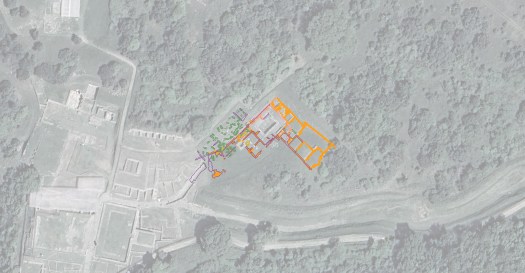
 Interconnected Mobility of People and Economy along the River Ombrone