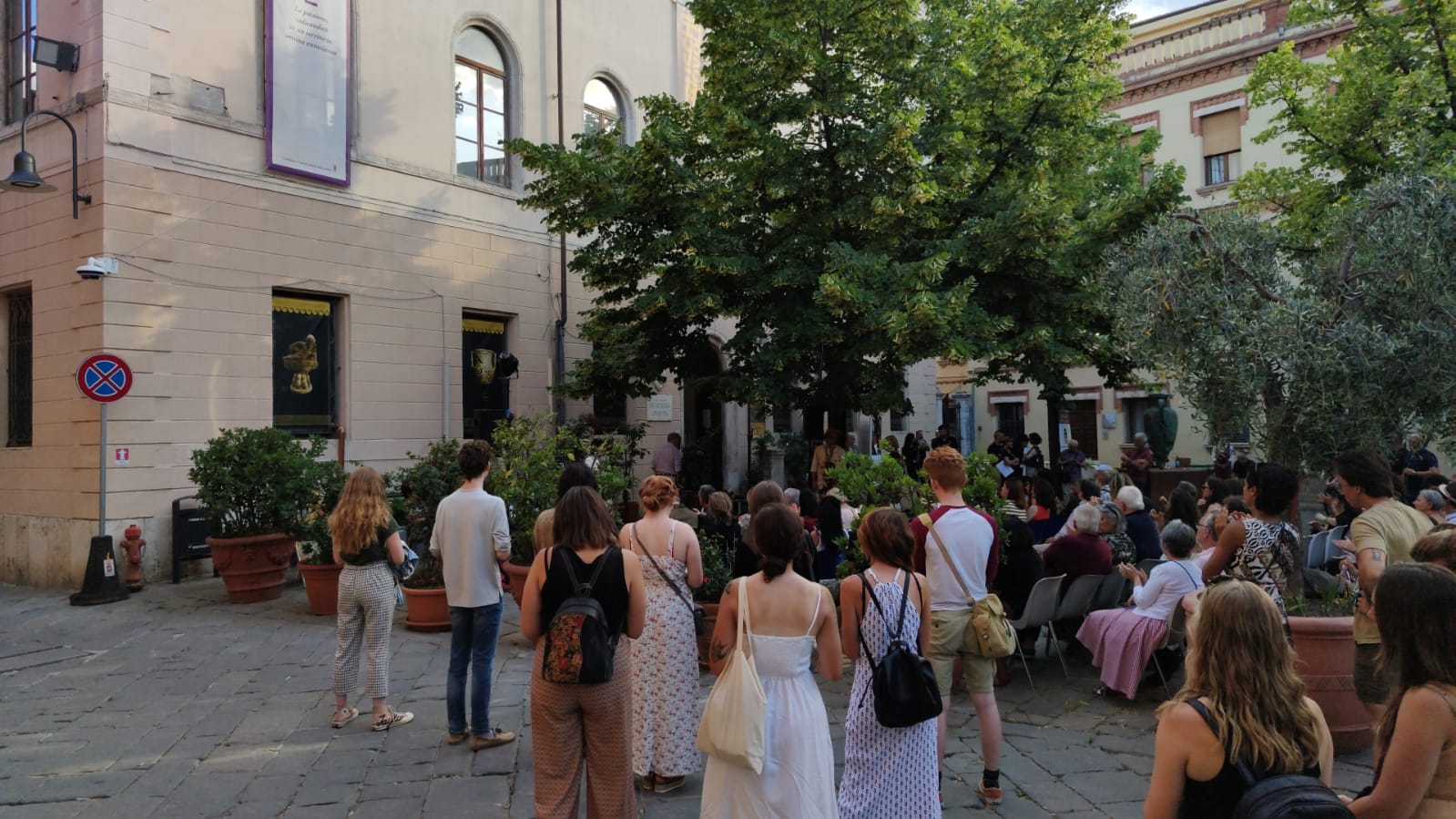
To finish the day, the team reached Grosseto to attend the opening of the archaeological exhibition on the late Etruscan necropolis of Casenovole, organized by our very good friends of the Associazione Archeologica Odysseus. What a blast!
Day trip – Part 1
Today, the research team of the Impero Project went to visit Murlo and its museum. Here is a picture of Michael, celebrating his birthday, by illustrating the site of Poggio Civitate!
Happy birthday to you Michael, from all of us! And thank you Besty for the beautiful picture!
Podere Cannicci – Day 13 (June 10, 2022)
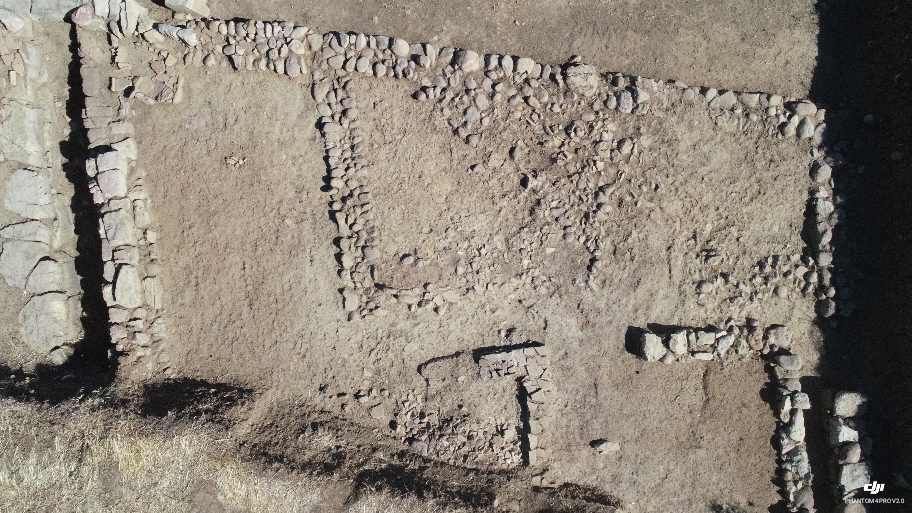
Even today, the Cannicci team split in two groups: part of the team joined Michael to wash and organize the findings from this three weeks of excavations. The rest of the team continued the fieldwork by removing part of Context 60. The layer is by far the most amazing and interesting of all the layer excavated in Area 1. Inside it, the team has found hundreds of shards of pottery, bricks and slag. Nevertheless, singular findings like a couple of clay seals for bellows (possibly related to kilns for smelting iron) and wasters from a nearby pottery kiln were stillfound.
In the morning professor Gregory Warden and his research team visited the site and the team in Cannicci. They were given a tour by Betsy and Marta through the many wonders of the Cannicci site. The students had the occasion to meet and quickly share experiences, enriching themselves and the whole project. Soon, the two teams will meet again on the Etruscan site of Potentino, where Professor Warden is now working.
The week ends with the hope to start digging the new phase that is starting to appear in the Cannicci site.
Visit from the Potentino Project
Today, we had the pleasure to host a visit from the research team working at the Potentino Castle. The team and the students guided by Prof. Gregory Warden enjoyed their time at Monteverdi and Podere Cannicci, learning from our discoveries and exchanging ideas.
Looking forward to paying a visit to them as soon as possible!
Castellaraccio di Monteverdi – Day 13 (June 10, 2022)
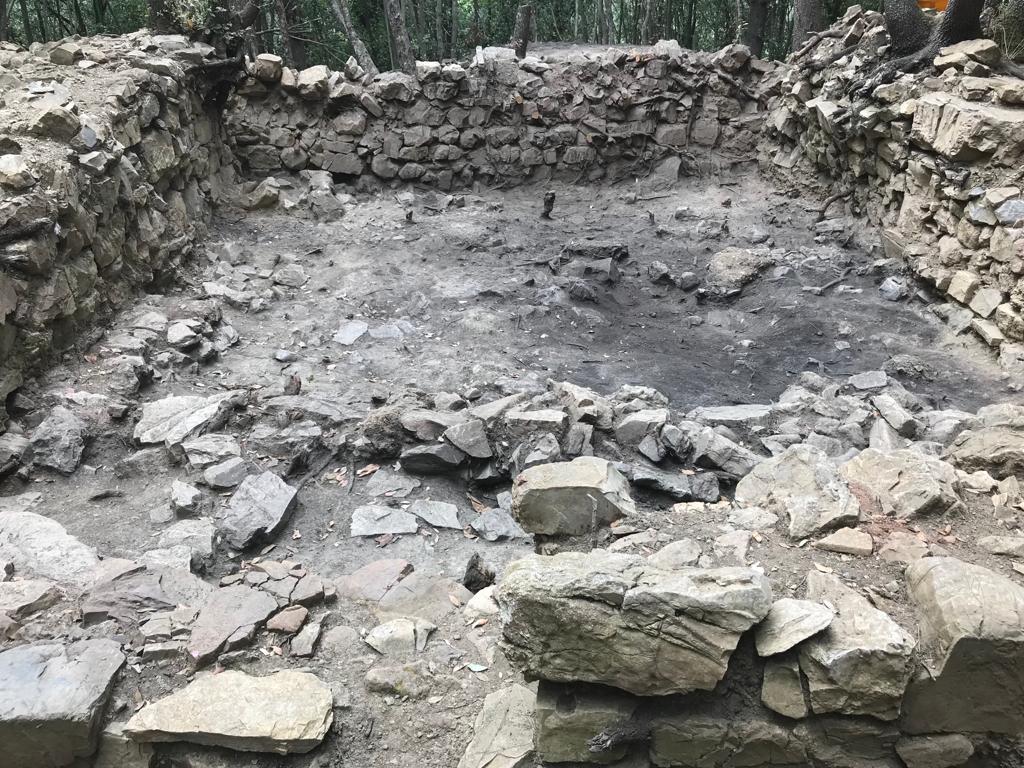
Today we finished removing layer 55 and cleaned the whole area for photogrammetry. In the meantime, we continued to sift the layer full of burnt seeds. In the afternoon, Todd came to help us with the cleaning work.
Castellaraccio di Monteverdi – Day 12 (June 9, 2022)
Despite a summer storm that blocked the works at the castle this was a lucky day at the site. In the morning the team continued to remove context 55 and to undertake smaller interventions in crucial points of Area 2000 to solve or doublecheck some crucial stratigraphic connections between contexts.
However, the crucial moment arrived when we started to remove the large stone placed in the central-northern area (context 97). This stone has been interpreted as a sort of working surface due to the presence of several sings on its surface probably generated by the abrasion of some tools. Precisely under this stone we found a ring decorated with an hexagonal blue glass. This find, while extremely interesting, it is a bit in conflict with the phase marked by the black layer 55, which seems to denote a workshop area dedicated to storage or processing cereals. Later during the day, context 55 also restituted a weight, possibly for fishnets. Also in Area 3000 interesting finds are starting to appear. Here Ryan completed the documentation and excavated a new layer from which a new knife blade was recovered. This concluded another exciting day of work at the castle.
Podere Cannicci – Day 12 (June 9, 2022)
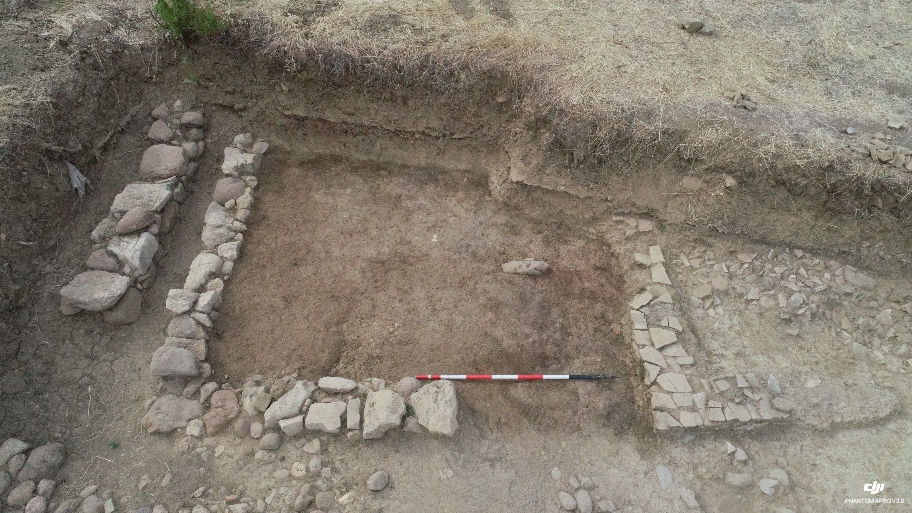
The Podere Cannicci team undertook diverse tasks today yet completed a tremendous amount of work. Several students, under the supervision of Michael, washed and organized ceramic materials that had been previously recovered during our excavations while Federico and Betsy led the rest of the team in finishing the removal of Context 75 and in fully exposing and cleaning Contexts 73 and 60, which respectfully refer to levels of collapsed brick and tile and what may have been a floor foundation of packed stone, tile, and other spoliated elements.
By the afternoon, these efforts had been completed, and Edo, Federico, and Betsy supervised the students as they sketched and photographed the strata that had been brought to light. After this, the team began to remove Context 60, bringing up impressive fragments of ceramic as well as misfired tile, evidencing production in the vicinity. The students were full of excitement as they filled multiple bags of pottery and drew large bones, slag, and structural elements from the earth.
Furthermore, partway through the day, Betsy and Dr. Fabiana Fabbri, the project’s votive specialist, left with Edo and Jacopo, one of our project’s gracious hosts, to conduct a field survey at a place called Fonte Cavalli along Monteverdi’s slopes. These investigations returned some tile and ceramic fragments as well as a clearer understanding of the zone; the area will continue to be scrutinized in the coming days.
Despite splintering into different teams, there was ample time for the Podere Cannicci crew to both educate and to push their respective projects forward. We are looking forward to the wonders that our final week will bring!
An unexpected discovery at Podere Cannicci
In the last few days, the research team is investigating new portions at the late Etruscan and Republican site of Podere Cannicci. During these activities, an unexpected discovery happened. During the removal of the soil on a nearby hill, the remains of an elephant tusk appeared from the earth, providing a snapshot of the paleo-environment and fauna of this territory in the Pleistocene; the tusk can be dated around 150,000 years ago and definitely informs of a much more different landscape for Paganico and the middle valley of the Ombrone river.
Castellaraccio di Monteverdi – Day 11 (June 8, 2022)
This morning we received a visit from the Cannicci team. Michelle and Alessandro give them a full tour explaining the historical context into which Castellaraccio was inserted and the archaeological situation we are encountering. Ryan also explained the finds from his test pit. Most of the rest of the day was spent in removing other parts of 55 and cleaning the older parts of the excavation in Area 2000 now that we are unifying the part we excavated this year with it. Ryan and Benedetta documented the extension of Area 3000 while Nolan and Leeanna completed the cleaning of Area 1000
Podere Cannicci – Day 11 (June 8, 2022)
The day started with the teams meeting for a visit to the Castellaraccio, the medieval castle of Monteverdi being excavated by the team leaded by Alessandro Carabia. Professor Hobart showed the students the results of these two weeks of investigations: Cleo, Ryan and Benedetta worked hard to expose new layers of charcoal and ashes that revealed many burned seeds and other interesting materials probably collapsed during a fire. The visit was completed by a quick talk given by Edoardo about the use of total stations as accurate tools for topography and for documenting during the excavation.
The visit left everybody feeling uplifted and inspired. Two students, Leeanna and Nolan asked to join Alessandro’s team to help with the cleaning and documentation of the rampart of Castellaraccio.
The rest of the team returned to Cannicci to continue the excavation of the Area 1. Edoardo organized the team in smaller groups and they all together tackled the raw floors still covering part of the excavation area.
A strange raw of stones was revealed under one of the floors and it is still unclear whether it is a wall or not. Other parts of the puzzle is indicating the presence of at least one previous phase which must have been very different from the students are excavating right now. We can be sure there was a workshop in the latter phase (the one we are digging right now), but we cannot tell what was there before the workshop and why did the workshop start in that place. The most interesting part is that the history of the site is getting way more complex than we imagined.