Podere Cannicci – Day 9

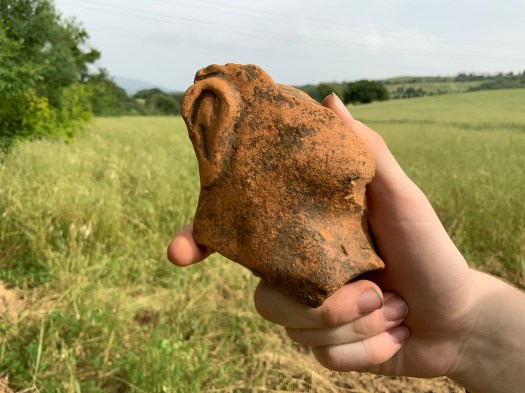
A new week at Podere Cannicci kicked off today, with all teams settling into productive rhythms. The team in Rooms I and V continued removing context 36 to expose the burn layer beneath it. While removing context 36, a few excellent finds resurfaced, they included a votive offering found by Kevin, and a lamp, and a black gloss pottery base with stamps dating it to the first half of the 3rd century BCE, between the first and second Punic Wars. Both the lamp and black gloss pottery base were found by Michael. In Room I, the corner of a wall was exposed, as well as an extension. In Room V, the side of the drain facing the rest of Room V was exposed, highlighting the continuation of the drain through the room, and possibly reaching outside of the current boundaries of the excavation. Smaller rocks have been found alongside the burnt context, emphasizing disturbance that is potentially due to collapse. Savannah and Dr. Fenton examined teeth and bone shards that were found in both rooms.  

In Area 1000, the team continued to expose the dolia and other pottery in context 2. Context 2 covered the dolia and contained evidence of a roof collapse, which is supported by the amount of roof tile that has been found. Today the team identified context 5, which is the context that the dolia sit on. Finds today included more iron nails, what is thought to be an iron door hinge found by Thuraya, iron fragments that are thought to be a part of a knife, more bronze objects that are in context 5 and cannot be removed just yet, and two incredible bronze bracelets, which were found by Tina. The team continued to remove context 2 until lunch, and during the lunch break, the initial artificial boundaries of the trench were expanded. After lunch, the team, now joined by Dr. Fenton, removed the topsoil of the new expansion, along with context 1, and began to expose context 2, which was identified by the burn marks, and reddish clay.
Castellaraccio di Monteverdi – Day 8

The end of the week has come, but everyone is happy to have another working day at Castellaraccio di Monteverdi. Like the teams’ usual mornings, everyone worked extremely hard to achieve the final goal: to uncover the entire castle and to find amazing artifacts in the process. Three medieval coins have been found yesterday, so everyone is more than willing to get hands-deep in the dirt to find more! Within Area 1000, there is more to find in context 10, which is characterized by loose, dark brown soil.

The team continued to work on their individual projects so that more information could be learned about the site. This medieval castle is beautiful to excavate, and while there have only been a couple of small finds throughout the week, everyone is still so eager to dig deeper; however, today was a relatively normal day. Everyone pickaxed, expelled heavy rocks, and shoveled a lot of loose dirt; although, during that time, Grant found multiple bricks and roof tiles through his amazing pickaxing skills. In addition, Alessandro found a artifact made out of metal. Everyone is super excited to perform further analysis on it in the future. 
In addition to our excavation, everyone received training regarding total station from Alessandro. Total station tracks the points of a site in order for maps to be created because it makes the whole archaeological process much easier. Marc also gave the rest of the team a very informational overview of the site that he has been working on: essentially, the house has a type of room identified outside called a trash midden due to the random artifacts that have been found there. It usually ranges from pottery and faunal remains, but Marc found both a glass base and spindle whorl fragment in one day! Everyone hopes to find more goods within that trench. On Monday, Area 1000 of Castellaraccio will continue to herald context 10 until we uncover more of the wall; we are hoping to acquire more artifacts (specifically coins) in the process! 

Podere Cannicci – Day 8

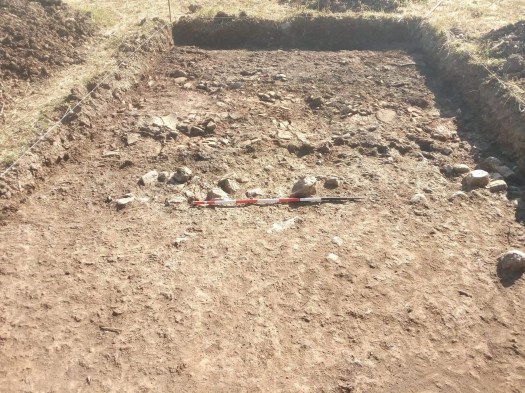
This morning was extremely foggy at Podere Cannicci, but that did not slow down our excavation. On the same site dug in 2017-2018, our goal was to continue our plans from yesterday to remove the interface between context 36 and expose the next context. Unsure of how deep the next layer was or how far the layer itself went, we had to carefully trowel away the clay. We were looking for black clay, green-yellow clay, reddish-brown disintegrated tiles as a signal of the next context, but there were several points where it seemed to disappear only for it to be several inches deeper than expected. Throughout the day we found several iron nails, bone fragments, and lots of pieces of pottery including a large base piece. We originally thought wall 8 extended, but further exploration lead us to discover that the rocks were just pebbles embedded in dried clay, mimicking larger rocks in a wall formation. Though the hypothesis of the wall extending is still a contender, we need to have stronger evidence in order to draw a definitive conclusion. On Monday,we plan to continue our work to stretch our excavation past what we previously believed to be the wall.

The other half of the team who worked at Area 1000 had a very busy and productive day. Their goal was to continue to explore context 2 which was similar to the other site at Podere Cannicci with burned charcoal, clay, and disintegrated bricks. Near the southeastern bulk, several pieces of pottery shards were found and are theorized to have come from three separate bowls. Among the pottery there were also iron nails, an alloy weight, a bronze fibula, and even a piece of lead likely used to repair the dolia found on previous days which was found by Thuraya. On the western bulk against the limit of the wall, Tina found a pocket of rodent bones while articulating one of the dolium.  All members of the team also found charcoal samples that were likely part of the beams that once ran across the roof structure. On Monday, the Area 1000 team plans on continuing their work articulating artifacts that are believed to be sitting on the floor of the next context. 


Podere Cannicci – Day 7

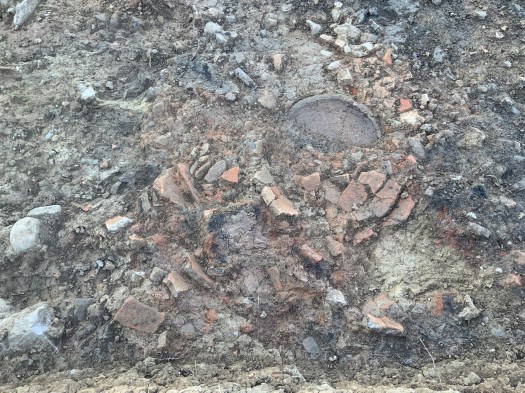
The Podere Cannicci team braved the heat today to continue the work undertaken during the previous afternoon. The students centered in the area excavated during the 2017 and 2018 seasons endeavored to fully remove the brown clay of Context 36 in the extended portion of the excavation to expose a burn-layer, characterized by charcoal, dark red clay, disintegrated bricks, and an abundance of pottery fragments.Several iron objects, including nails and a hook, were found in the process of reaching this layer. Further, this context seems toboth cut beneath rocks that appear to be a continuation of wall 8and to be consistent with the burn layer within Room I exposed in 2018; since this room has accumulated clay between the excavation seasons, the team’s next task is to bring the charcoal-laden clay back to the light and confirm or deny its consistency with the newly uncovered context residing in Room I. In the other direction, it is also possible that the hypothesized wall formed different stratigraphic basins between Rooms I and V, so the following days will be marked with an investigation of the context’s continuation towards the southern end of the site. The possible continuation of the wall itself will likewise be articulated, and other, curiously aligned stones will be investigated over the coming week. 

The team at Area 1000 likewise worked on the contexts unearthed during the previous day, particularly Context 2, defined by charcoal, disintegrated brick, yellow and grey clay, all which find parallels in the aforementioned soil reached by the other team, as well as the presence of dolia, and Context 3, a brown layer with visible inclusions. Context 2 heralded numerous finds, including iron nails, dolia sherds, a tile with a maker’s mark, a bronze object, and ceramic sherds of interest. In the morning, Dr. Edoardo Vanni taught the students working in the trench with him to use Total Station, create maps, and properly employ context sheetsdocumenting and taking points of Contexts 2 and 3 and the charcoal lines likely demarcating wooden beams; then, they set to work removing Context 2 and the scattered sherds of dolia while retaining the bases and those sherds in situ in the belief that the team has reached the floor.They plan to continue articulate those dolia in situ, confirm the floor, and remove Context 3. 

On either side of the trees, the excavators at Podere Cannicci have begun the work of understanding both the pervasive existence of charcoal-laden clay at the site and the interaction and functional separation of these nearby areas. There is still much work to be done, but the team welcomes the plethora of questions and conjecture arising from our discoveries. 

Castellaraccio di Monteverdi – Day 7

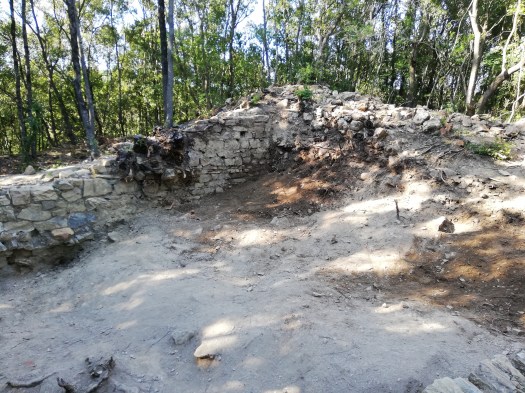
Thursday was quite the eventful day at Castellaraccio. Alessandro and his team worked hard to continue clearing out the last of the collapsed walls of the castle, reaching the outer wall of the complex. Marc continued to excavate the small area outside of the threshold of the house, finding more pottery and bone fragments.

Finds have been hard to come by in the palace (area 1000), and the team expected to have another day full of pickaxing, hauling rocks, and shoveling bucketful of dirt. Among the first finds of the day were building materials such as tile and brick fragments, and two bones. Just before lunch, Alessandro made a huge discovery; A coin was found in the collapse! This called for a more attentive excavation of the area where the coin was found, a metal detector quickly became a relied upon tool. Almost immediately after the initial find, Megan and Lilli found two more coins! The team was beyond lucky to have found not just one coin, but three all within about five minutes! This lead to more careful excavation around the area, unfortunately, no more coins were found.

The rest of the day at Castellarracio was brightened by the light of wonderful finds which reinvigorated the efforts to finish excavating the collapse. 

Podere Cannicci – Day 6

After two days spent with the entire team of excavation in the Podere Cannicci site, for preliminary operation of cleaning, the two groups have been divided in two, one at the Castle and the other at the Roman site.

Today the students working in the main area have continued to remove the context 36 and exposing a black and red burned layer that we have already recognized and partly excavated in the previous campaigns. This layer probably testifies an extended fire widespread all over the site. Few polished river stones have appeared from the removal of what remained of the context 36, possibly interpretable as a wall of Room II, perpendicular to wall 8.

In the other trench (Area 1000), the participants have removed context 1 that covered the entire area. In cleaning up the area with extremely accuracy, a new context appeared, black-red with a number of pieces of broken jars (dolia), roof-tiles and bricks, probably the first collapse of a storage room. A wall has come to light with an orientation N-S, placed in the center of the area and it divides the area in two parts. One is occupied by the collapse and the other by a brown-black layer poor in materials, indicating possibly an outside area. In the S-E part of the area a series of underground jars (at least 3 now are visible) posed in line. Context 1 has been given back few fragments of black-gloss ware, essentially Campana A, B and B-oide type (from half of the third century to the half of the second century BC onwards). At the end of the day the team of the area 1000 has finished to clean all the layer and took photos of the new contexts.

Castellaraccio di Monteverdi – Day 6

This was the first day in Castellaraccio this week, since all the team was concentrated in Podere Cannicci during the last two days. The site deeply changed by the team during last week and it is almost ready for some proper archaeological stratigraphy.

Most of the collapse was removed in both Area 1000 and 2000. Marc and Michelle are wonderfully working on a little test pit (Area 3000) on the southern side of Area 2000, where most of our new finds have been recovered.

While Marc and Michelle were working there, Alessandro and the rest of the team were removing the earlier phase of the collapse (context 10) left in Area 1000. At the end of the day, after a lot of pick axing and shoveling only a small section of the collapse was left on the eastern site of the room.

We called the day and we came back home, we stuck the van in the mud and Alberto came to push us out with the tractor.

Podere Cannicci – Day 5

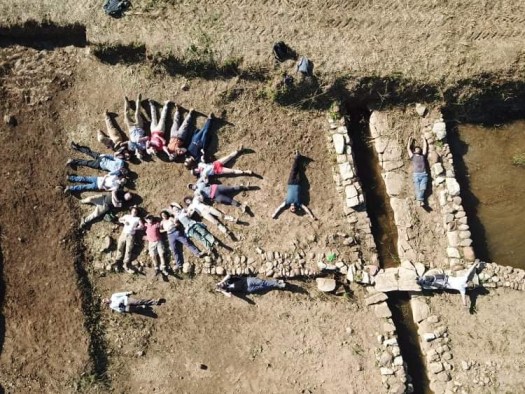
Today was the last day of combined effort at Podere Cannicci before the students assigned to Castellaraccio return to the structures uncovered a week prior. One team under the supervision of Michael McCabe focused on weeding and cleaning the previously excavated Room II while a second team led by Elisabeth Woldeyohannes under the guidance of Alessandro Carabia continued to remove the soil of Context 36 to make it level, moving in two groups to meet at the southeastern corner of the site. One of the excavators under Michael, Lilli Antonelli, discovered terra sigillata fragments in Room IV, the team under Elisabeth found a worn bronze coin, and both groups documented a large amount of both black gloss ware and coarse ware as well as bronze and, mostly, iron slag. On a macro scale, students and directors measured the limits of the excavation using Total Station and sketched the site before lunch; afterwards, Alberto Ghini assisted in draining the water from Room III, which was excavated in the previous year, and Pepa Souček took a photo of the site upon its cleaning. 

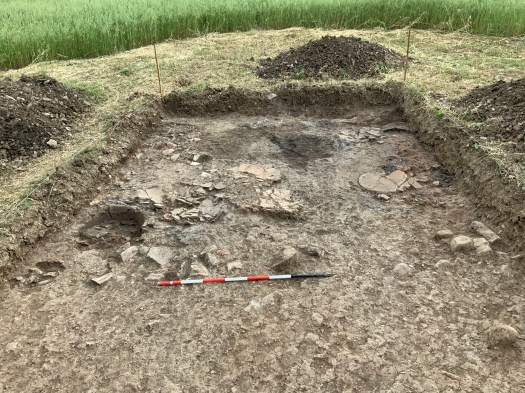
On the other side of the trees, a small group led by director Dr. Edoardo Vanni found numerous objects and avenues of interest in Area 1000 upon reaching a burnt layer of charcoal and red clay in the excavation’s eastern end. These include three dolia, one defined by its edge in the corner of the area and the other seemingly collapsed inward, possible carbonized beams which left charcoal streaks, a potential necklace found in the middle of the burnt area, a possible door hinge found on the site’s northern end, broken iron nails, and a solid metal object, made of iron and likely lead, of unknown significance. This group spent the day attempting to reach the red clay amidst the burn layer. 

Over the following days, the IMPERO team plans to both create a trench crossing through Rooms I, V, and the southernmost drain in the main excavation area and to continue to expose the charcoal and red-clay context at Area 1000, investigating aligned stones which possibly indicate a wall as well as the finds and features already discovered. While the work is strenuous and the goals are large, the team remains both ambitious and light-hearted—making playful bets with one another and bonding over music as we strive to understand Podere Cannicci’s past.

Podere Cannicci – Day 4

Due to some particularly rainy weather last week, the team was unable to start working at Podere Cannicci until this Monday. To make up for the lost time, our entire group pitched in, splitting into 3 teams: some clearing out the first contextual layer in Room 5 of Podere Cannicci others attending to Room 1, and a small group of Dr. Vanni and Thuraya excavated at area 1000, an expansion to the prior years excavation due to findings from the Geo-Radar suggestion there was materials below, one such discovery being a dolium. 

The day’s tasks consisted of the removal of the uppermost contextual layer of soil. The teams used pick-axes to turn up the surface level of dirt, followed by a series of shoveling to clear the debris from the site. The team kept a keen eye out for any pieces of pottery, black glossware, iron slag deposits, metal tools, or any other items with archeological significance to the excavation. Thankfully, the site was no longer under water, and the water pumps from the days prior made it possible to shift through the thick clay and soil to identify evidence of the lives lived long ago. 

Some of the mentionable findings of the day included several loom weights, animal bone fragments, and several iron nails in both Room I and V. Even just within the top contextual layer of Podere Cannicci, our team found an immense amount of pottery fragments and broken black glossware, which helps us to paint a picture of the Roman Republican civilization’s kiln work,  orientation, and day to day operations.

As we document the team’s findings and begin to uncover the walls surrounding Room I and V, we are hopeful to find more useful artifacts in the following contextual layers and uncover more about the peoples from this beautiful area in Tuscany throughout its inhabitation.  

Castellaraccio di Monteverdi – Day 5

Today spelled not only the end of the week but the final moment of joined effort at Castellaraccio. After putting tremendous hard work and comradery into both the keep, Area 1000, and the house, Area 2000, even the students more inclined towards the Classical site were filled with the joy of this priceless experience engaging with the Middle Ages. 

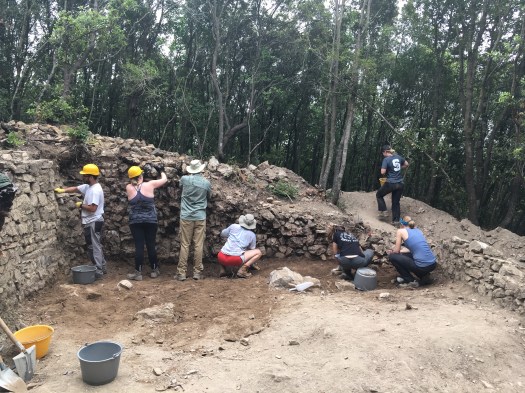
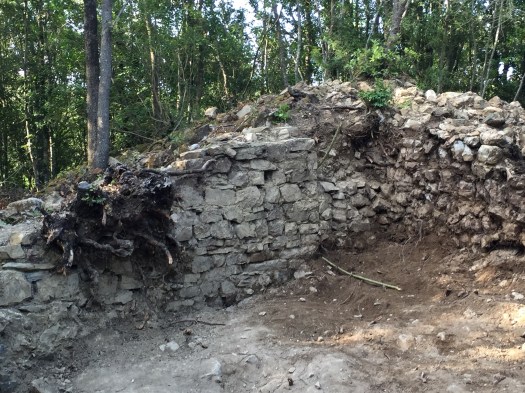
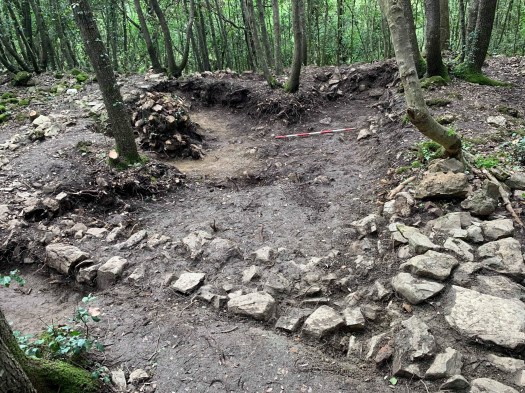
At the keep, students removed yet another invasive stump and well-defined the walls of the area—training their eyes to differentiate tile from stone and mortar from soil. Deeper into the covering of trees, excavators at the house likewise began with the mission to better define the walls of the perimeter and search for mortar to assist with that goal. Along the northern wall, students began by lowering the soil along its base, evening it to the level of the portions of the room’s interior dug over the preceding few days. Despite this, the wall proved too damaged by tree roots, and its edge was obscured by its collapsed state; therefore, students began to work alongside the external side of the northern wall’s collapse, following the alignment of three stones discovered yesterday. This new plan proved significantly more fruitful, suggesting that the wall’s position was further back and more truly in alignment with the visible external castle wall as well as elucidating the trajectory and original position of the collapse most drastically affected by the growing trees. The students along the western wall conquered the invasive flora even more fervently, with site supervisor Michael McCabe and student Thuraya Hazer finally meeting on the other side of an enormous and pervasive stump that has, until now, largely prevented them from fully defining the structure. On the eastern wall, the early morning likewise came with the conquest of several problematic tree roots, and these triumphs revealed this wall to be deeper under the collapse than previously postulated as well. 

In Context 2, in a trench directly outside the southern wall in its western corner, Marc Hunter continued to find chronologically significant pottery and, in addition, discovered charcoal within the southern wall on its external side. Directly below this charcoal, however, Marc brought to light a series of stones which may indicate a threshold—providing potential answers for questions of the house’s orientation and layout in relation to the rest of the castle and the neighboring, so far unexcavated, structures. The team plans to extend the trench approximately half a meter on its eastern and southern sides to better understand this threshold in connection with the house’s perimeter as well as the extent of the hypothesized post-holes and their alignment. Although rejoicing in the onset of warm weather and the coming labor at Podere Cannicci, all participants at Castellaraccio are deeply moved by the opportunity to uncover the traces of life in the Middle Ages, to hold unfamiliar pottery in their hands, and to imagine inhabitations from root-torn rubble; they will miss their trenches in the trees.